Why Pages Are No Longer Enough
Why page content becomes difficult to reuse across channels, and the problem that structured, presentation-independent content is meant to solve.
Start with the content that should not be copied
Modules 1 and 2 explained how AEM renders and authors pages. That works when a page is the only consumer of its content.
The boundary changes when the same product description, policy, or profile must appear in a page, an app, and another delivery channel. Copying it into each experience creates separate ownership and separate updates. The question for this module is simpler: what content should exist independently of a page?
When Pages Were Enough
For many years, websites were the primary way organizations communicated with their customers.
A visitor opened a browser, requested a webpage, and the CMS returned a fully rendered HTML page.
This approach worked well because every customer consumed content through the same channel.
If a marketing team wanted to publish a product announcement, they created a webpage.
If they wanted to publish a press release, they created another webpage.
Everything revolved around pages.
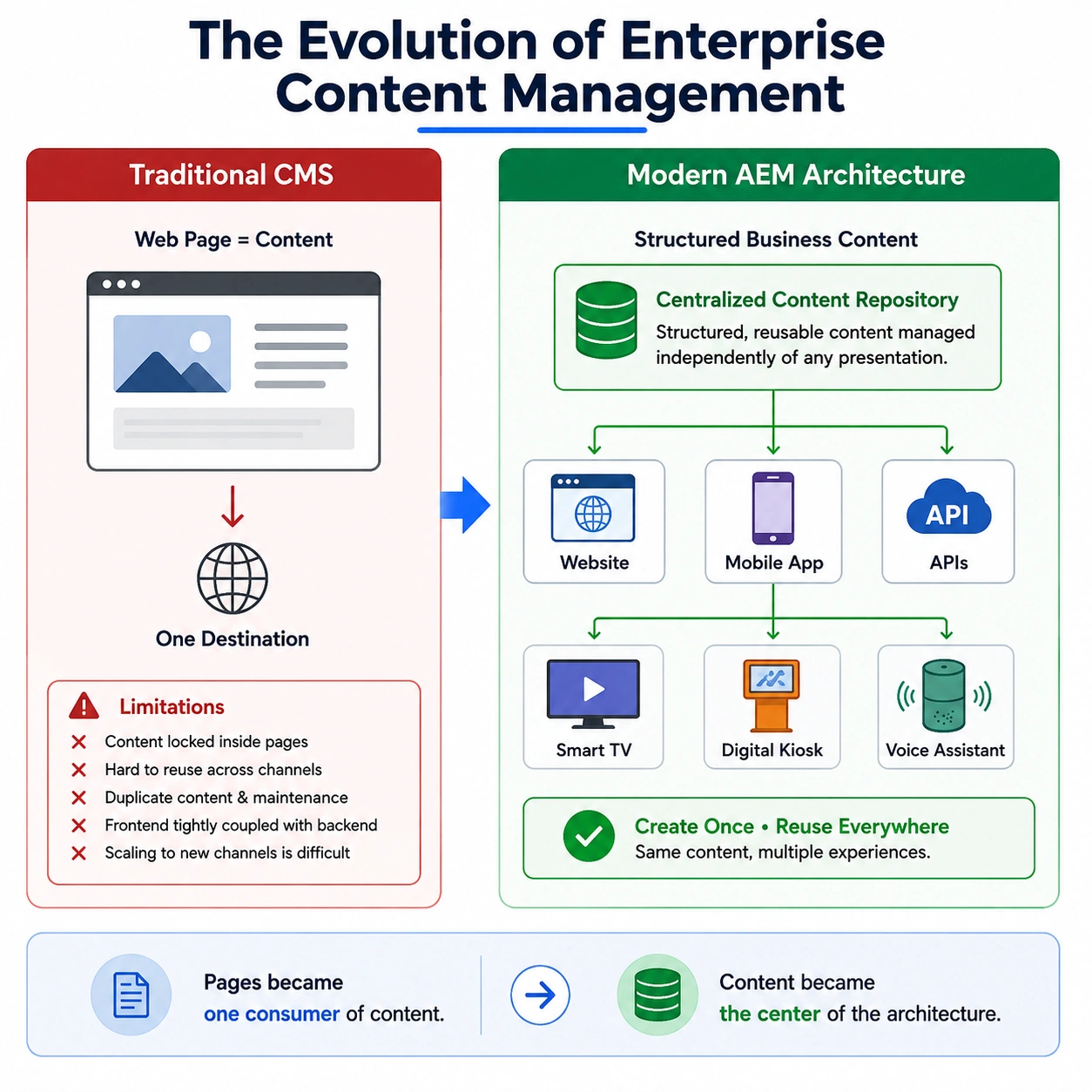
In fact, early CMS platforms were designed with this assumption.
Content and presentation lived together.
The page contained the layout, styling, navigation, and business content as a single unit.
For traditional websites, this architecture was simple, reliable, and effective.
There was no reason to separate the content from the page because the page itself was the final destination.
Architect Perspective
Traditional CMS platforms were designed for a world where websites were the primary digital channel.
As long as every customer consumed information through a browser, combining content and presentation inside a webpage was a practical and efficient design.
The architecture wasn't wrong.
It simply reflected the needs of that time.
When One Website Became Many Experiences
Over the last decade, the way people consume digital content has changed dramatically.
A website is no longer the only place where organizations communicate with their customers.
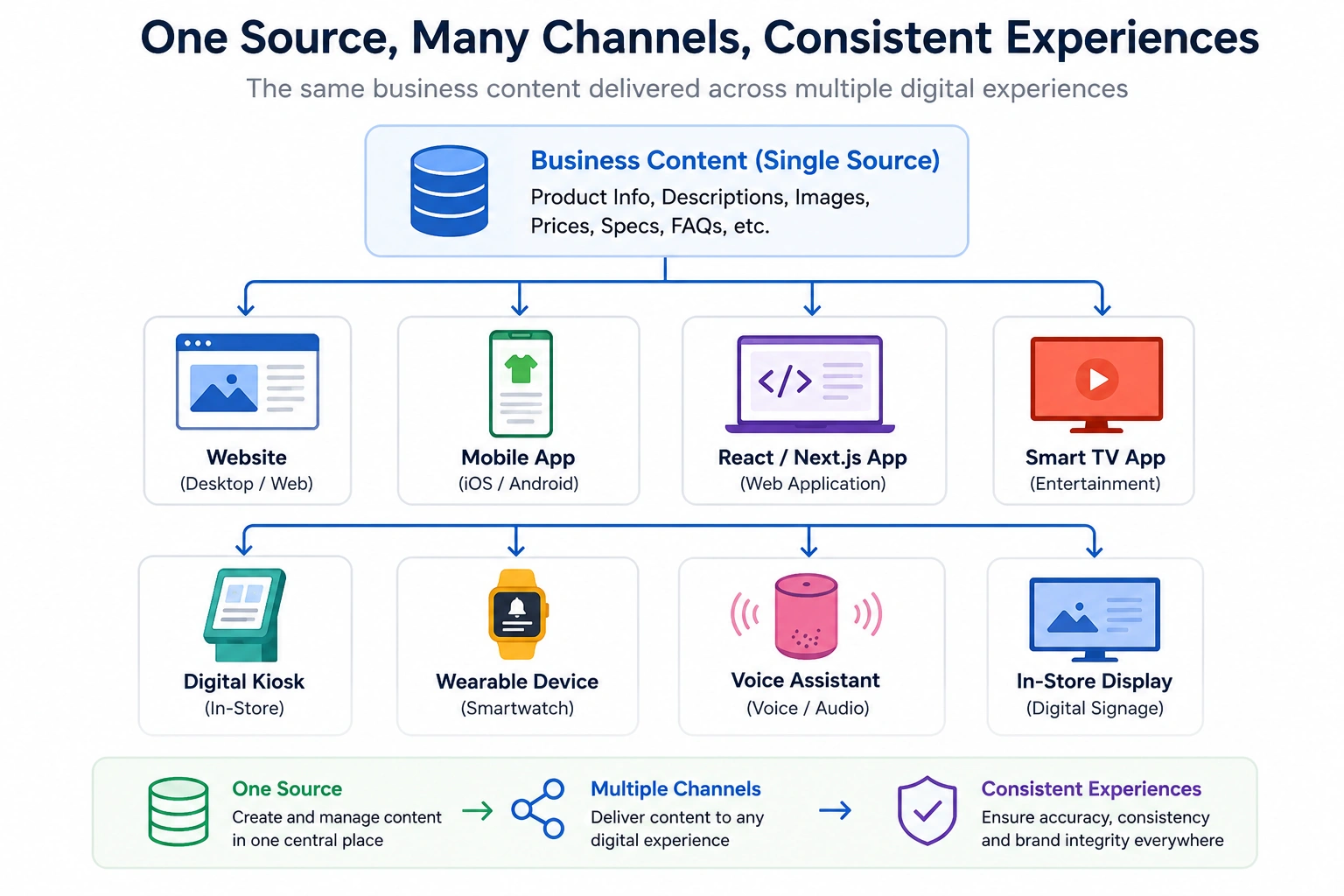
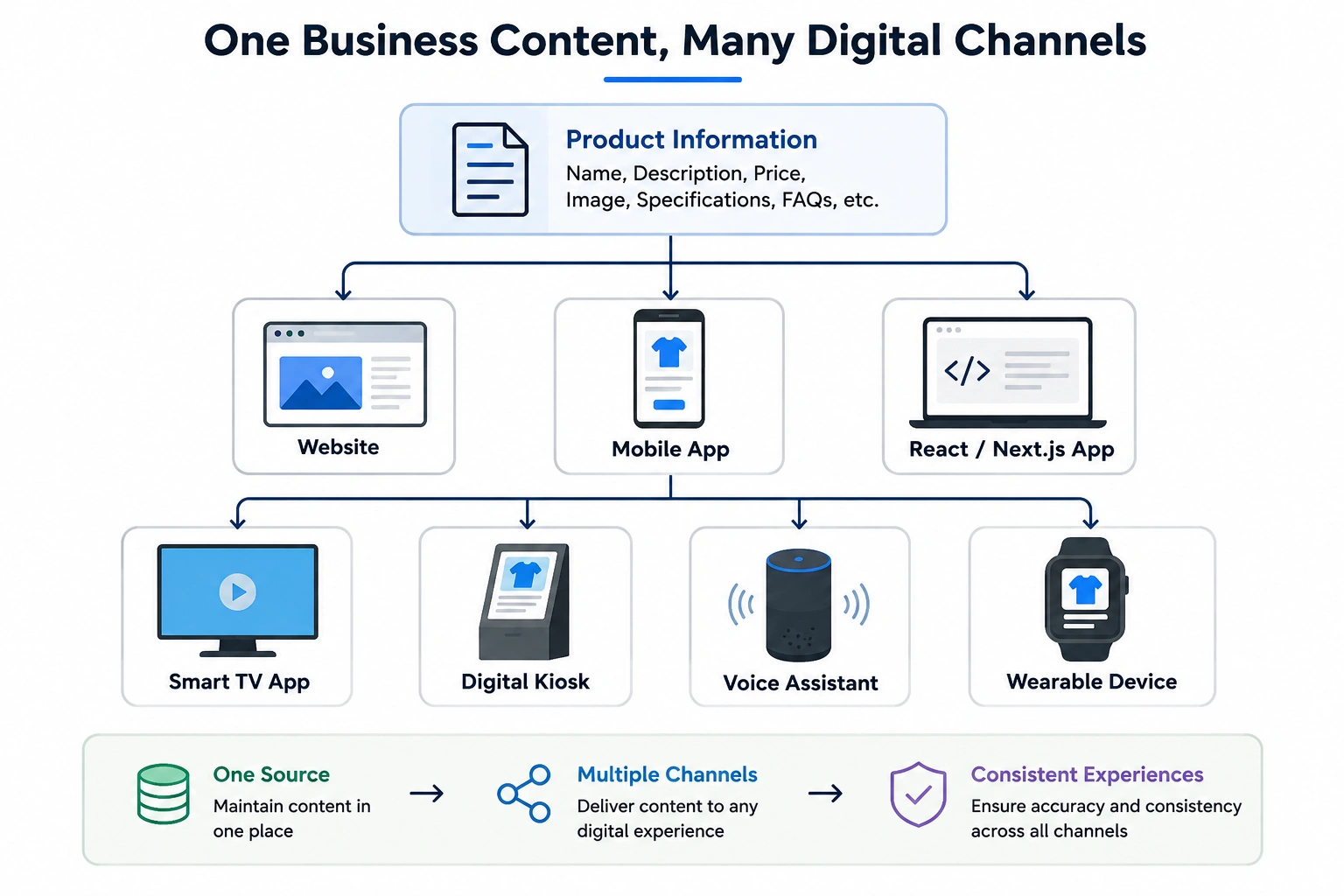
Today, the same business information often needs to appear across multiple digital channels.
A product description might be displayed on:
- A company website
- A mobile application
- A smartwatch
- A digital kiosk inside a retail store
- A voice assistant
- A smart TV application
- An in-store display
- A React or Next.js application
Although these experiences look completely different, the underlying business content is exactly the same.
Only the presentation changes.
This created a challenge for traditional page-centric CMS platforms.
If every channel requires the same information, should every team create its own version of that content?
Imagine updating the description of a single product.
If that information exists inside multiple webpages, mobile applications, and other digital channels, every copy must be updated separately.
Besides increasing maintenance effort, this also introduces the risk of inconsistent information across channels.
The problem is no longer about building webpages.
The problem is managing content that needs to live beyond a webpage.
When Content Became More Important Than Pages
As organizations expanded their digital presence, they realized something important.
Customers weren't asking for webpages.
They were asking for information.
A product description should remain the same whether it's displayed on a website, inside a mobile application, or on a digital kiosk.
The content doesn't change.
Only the way it's presented changes.
This led to a fundamental shift in how enterprise CMS platforms were designed.
Instead of managing webpages as the primary asset, Modern content architectures increasingly treat reusable content as an independent asset rather than tying every piece of content to a single page.
Pages became just one way of presenting that content.
This separation offers several important advantages.
Content can be created once and reused across multiple digital channels.
Frontend teams can choose the technologies that best suit their applications without depending on traditional webpage rendering.
Content authors no longer need to duplicate information for every channel, reducing maintenance effort and ensuring consistency across the entire digital ecosystem.
This shift from page-centric architecture to content-centric architecture became one of the biggest changes in the evolution of enterprise content management.

The Birth of Content-Centric Architecture
Once organizations recognized that content needed to be shared across multiple digital experiences, a different approach became necessary.
AEM supports a content-centric approach in which structured content can be managed independently of a page and reused across different experiences.
This allowed the same information to be authored once and delivered to many different destinations without duplication.
For content authors, this meant managing information instead of maintaining multiple copies of the same page.
For frontend teams, it meant consuming content using the technologies that best suited their applications.
For architects, it introduced a clear separation between content management and content presentation, making enterprise solutions easier to scale and adapt as new channels emerged.
This architectural shift laid the foundation for modern Headless AEM.
Before we can explore APIs, GraphQL, or frontend integrations, we first need to understand the building block that makes this approach possible.
That building block is the Content Fragment.
Production Reality
Imagine a healthcare company updating the product information for a medical device.
Then:
- Public website
- Patient application
- Pharmacist portal
- Hospital kiosk
- Support systems
If each platform stores its own copy of the content, every update becomes a manual process.
Besides increasing maintenance effort, it also creates the risk of inconsistent information reaching different audiences.
Modern enterprise platforms avoid this problem by maintaining a single source of truth for business content.
Each channel retrieves the same approved content and presents it in a way that suits its own users.
This approach reduces duplication, improves consistency, and allows organizations to introduce new digital channels without rewriting their content.
Architect Perspective
One of the biggest changes in enterprise content management wasn't a new framework or a new API.
It was a change in mindset.
Experienced architects don't begin by asking how a page should look.
They begin by asking how content should be modeled, managed, and reused across the organization.
Once content becomes independent, the presentation layer can evolve freely.
New websites, mobile applications, frontend frameworks, and future digital channels become consumers of the same business content rather than isolated systems with duplicated information.
That's the architectural foundation we'll build on throughout the rest of this module.
A New Way of Thinking About Content
The shift from page-centric to content-centric architecture wasn't driven by technology alone.
It was driven by changing business needs.
Organizations wanted to publish the same information across websites, mobile applications, digital signage, and emerging platforms without maintaining multiple copies of the same content.
To achieve this, content had to become independent of presentation.
Instead of asking:
- "Which page should this content belong to?"
Teams started asking:
- "Which channels should consume this content?"
That simple change in perspective transformed how enterprise CMS platforms were designed.
Pages became one way of presenting information.
Content became the foundation of every digital experience.
This architectural approach allows organizations to adapt as new channels emerge without redesigning their content strategy.
Modern AEM embraces this philosophy by treating structured content as a reusable asset that can be consumed wherever it's needed.
The decision to carry forward
Content Fragments are reusable pieces of content. The next chapter introduces the AEM structure that supports that decision: Content Fragments.
Enjoyed this chapter?
Get an email when I publish the next chapter. No spam — just new technical deep-dives.
Comments
Share feedback or questions about this blog post.
No comments yet. Be the first to share your thoughts.